

Introduction to State Management in React
Understanding application state
State management is one of the most important concepts in React development. It controls how data flows in an application and how components interact with each other. As applications grow larger managing state becomes more complex and requires structured solutions.
Why developers need structured state handling
In modern web applications multiple components often share data. Without proper state management developers face issues like prop drilling and inconsistent UI behavior. This is where tools like Redux and Context API become essential for scalability and maintainability.
What is Context API in React
Basic concept of Context API
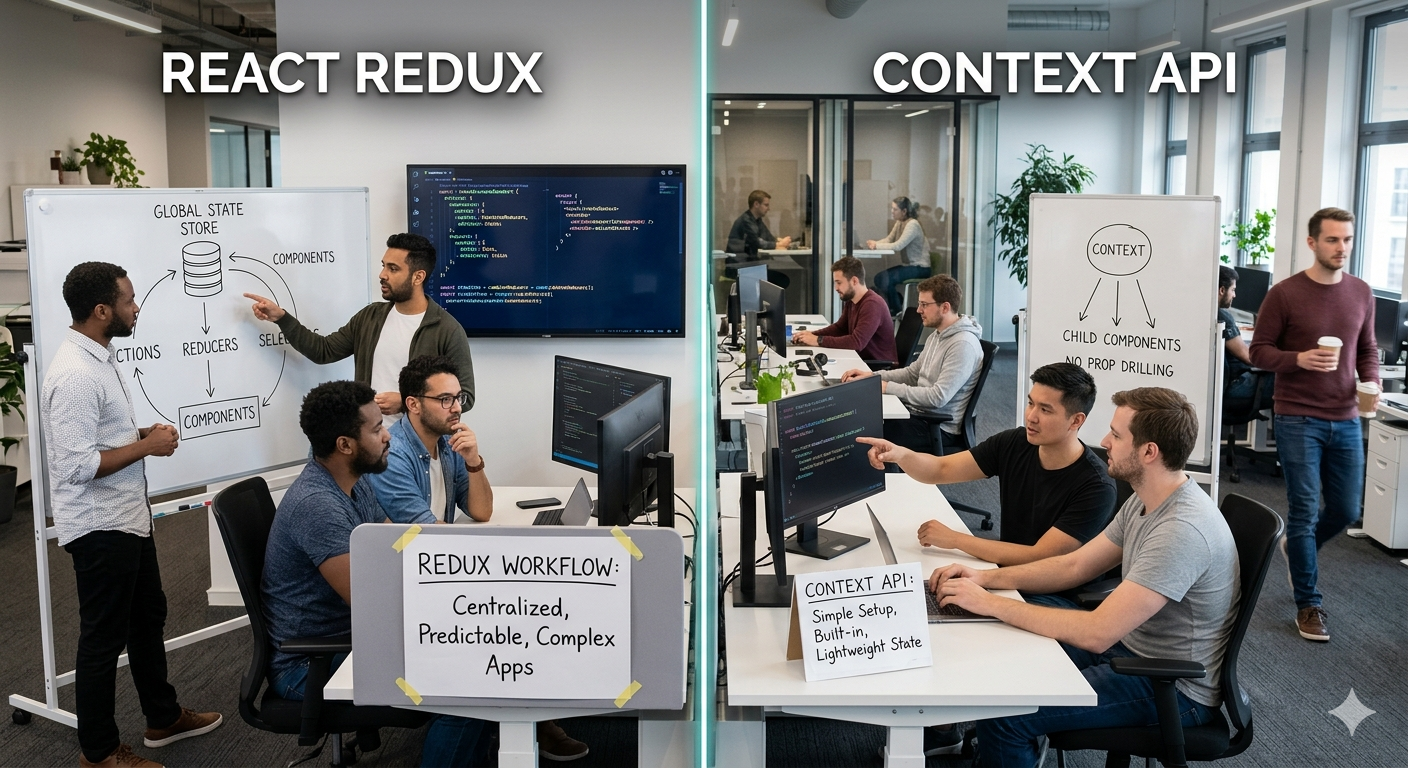
Context API is a built in React feature that allows developers to share data across components without passing props manually at every level. It simplifies state sharing for small to medium applications.
When Context API is useful
Context API works best in applications where state changes are simple such as theme switching authentication and language settings. It reduces boilerplate code and keeps the structure clean for lightweight use cases.
What is Redux in React
Core idea behind Redux
Redux is a predictable state container designed for large scale applications. It centralizes application state in a single store which makes data flow more consistent and easier to debug.
Key components of Redux
Redux works through actions reducers and store. Actions describe what happened reducers define how state changes and the store holds the complete application state. This structure makes debugging and testing easier in complex systems.
Redux vs Context API Key Differences
Performance and scalability comparison
Context API is lightweight but can cause performance issues when state updates frequently. Redux is optimized for large applications and handles frequent updates more efficiently through structured state updates.
Complexity and learning curve
Context API is easier to learn and implement while Redux requires more setup and understanding of patterns. However Redux provides stronger control and debugging tools for enterprise level applications.
Choosing the Right State Management Approach
Small applications vs large applications
For small applications Context API is often enough because it reduces complexity. For large applications Redux is preferred due to better structure and scalability support.
Best practices for developers
Developers should evaluate application size team experience and long term maintenance needs before choosing a state management solution. Mixing both Context API and Redux is also possible depending on requirements.
Conclusion
Final thoughts on state management
State management plays a critical role in React application performance and scalability. Choosing the right approach depends on project needs and architecture planning.
Future of state management in React
With continuous improvements in React ecosystem developers now have more flexible options. Understanding both Context API and Redux helps in building efficient and maintainable applications.